Difference between revisions of "Tektronix 4002"
m (→Images) |
m (→Images) |
||
| Line 222: | Line 222: | ||
File:Tektronix_4002A_Timing_Interface_Control.jpg | File:Tektronix_4002A_Timing_Interface_Control.jpg | ||
File:Tektronix_4002A_Timing_Interface_Control_Detail.jpg | File:Tektronix_4002A_Timing_Interface_Control_Detail.jpg | ||
| − | File:Tektronix 4002 Modern Data 1970-06 advertisement.jpg | + | File:Tektronix 4002 Modern Data 1970-06 advertisement.jpg|advertisement |
</gallery> | </gallery> | ||
Latest revision as of 13:40, 10 March 2026
| Tektronix 4002 | |
|---|---|
 | |
| Manufacturer | Tektronix |
| Model | 4002 |
| Lifetime | |
| Introduced | 1969 |
| Introductory Price | $8,000 |
| Discontinued | 1975 |
| Communication | |
| Interfaces |
RS-232B, 20 mA current loop |
| Baud Rates | 110, 150, 300, 600, 1200, 1800, 2000, 2400 |
| Display | |
| Size | 11-inch |
| Character Modes | |
| Resolution | 80x35 |
| Attributes | Normal |
| Matrix | 7x9 |
The Tektronix 4002 was a storage-tube computer terminal introduced by Tektronix in 1969 at a price of $8,000.[1][2] It was the first computer terminal product offered by Tektronix and formed the foundation of the company's early line of direct-view storage tube (DVST) display terminals.
The terminal employed an electrostatic storage display tube that retained displayed information without the need for continuous refreshing. This technology allowed the terminal to present complex text or graphical images with relatively modest interface bandwidth compared with raster-scan displays that would become common in later decades. Because the stored image remained visible until explicitly erased, the terminal was well suited to engineering, scientific, and computer-aided design applications where static diagrams and plots were frequently displayed.
The display provided an 80 by 35 character text format using a 7 by 9 dot character matrix. An 11-inch storage CRT was used for the display surface. Characters and vectors were drawn directly on the storage surface and remained visible until a screen erase operation was performed.
Communication with host computers was provided through asynchronous serial interfaces supporting RS-232B signaling or 20 mA current loop operation. The terminal supported selectable data rates ranging from 110 to 2400 baud. In addition to serial communications, Tektronix offered a variety of optional interfaces designed to connect directly to minicomputers of the period, including systems manufactured by Digital Equipment Corporation, Hewlett- Packard, and Data General.[3]
The 4002 was designed as a modular system. Interface electronics and optional interactive graphics hardware were installed in an internal card cage using plug-in circuit boards. This architecture allowed the terminal to be configured for a variety of host systems and application environments.
Interactive graphics capability could be added through the optional Interactive Graphic Unit modules. These modules allowed the terminal to operate as a vector graphics display capable of responding to cursor or joystick input. Such configurations were commonly used with engineering and scientific software running on contemporary minicomputers.
The Tektronix 4002 remained in production until approximately 1975. It was later succeeded by more capable terminals in the Tektronix 4000-series, including models with enhanced graphics capabilities and expanded display features.
| Part Number | Price | Description |
|---|---|---|
| 021-0001-00 | $675 | Type 4801 Parallel interface for DEC PDP-8 Series with negative I/O buses. |
| 021-0002-00 | $600 | Type 4802 Serial Data Communications Interface, RS-232 |
| 021-0003-00 | $675 | Type 4803 Parallel interface for DEC PDP-8 Series with positive I/O buses. |
| 021-0004-00 | $750 | Teletype interface for DEC PDP-8/I and PDP-8/L. |
| 021-0005-00 | $750 | Teletype interface for Data General Nova and Supernova. |
| 021-0006-00 | $750 | Teletype interface for HP 2114, 2115 and 2116. |
| 070-1059-00 | $525 | 4901 Interactive Graphic Unit |
| 070-1107-00 | $750 | 4902 Interactive Graphic Unit |
| 333-1624-00 | 4903 Interactive Graphic Unit | |
| $300 | 4951 Joystick |
Design and operation
The Tektronix 4002 used direct-view storage tube technology developed by Tektronix for oscilloscopes and adapted for computer display terminals. In contrast to raster displays, the storage tube preserved the image on the screen after it was written, eliminating the need for periodic refresh from the host computer.
Text characters were generated by internal character generator circuitry and drawn on the storage surface as a sequence of strokes forming the dot matrix pattern. Graphics could be displayed by plotting vectors between specified coordinate points. Once drawn, both text and graphics remained visible until the display was cleared.
The terminal incorporated internal digital logic to interpret incoming character codes and control the display writing process. Plug-in circuit boards located in the internal card cage implemented functions such as character generation, coordinate registers, digital-to-analog converters for beam positioning, and interface control.
An external keyboard provided character input and command functions. Cursor movement and graphical interaction could be performed using the optional interactive graphics modules and joystick.
Applications
The 4002 terminal was commonly used with minicomputers of the late 1960s and early 1970s, particularly in scientific and engineering environments. The ability to display stable graphical images made it suitable for plotting graphs, displaying circuit diagrams, and presenting technical drawings.
Systems equipped with the interactive graphics options allowed users to manipulate displayed objects using cursor controls or joystick input. Such configurations were used in early computer-aided design systems and other interactive engineering applications.
Manx
- 4002A Draw Unit and Keyboard Maintenance, January, 1971
Images


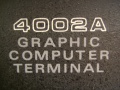


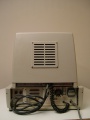


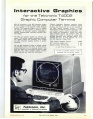
advertisement


External Links
References
- ↑ "Tektronix Catalog". Tektronix. 1969. http://bitsavers.org/pdf/tektronix/catalog/Tektronix_Catalog_1969.pdf. Retrieved April 20, 2012.
- ↑ "Tektronix Storage Tube Terminals". http://www.omen.com/tek/tek.html. Retrieved April 23, 2012.
- ↑ 3.0 3.1 "Tektronix Catalog". Tektronix. 1970. http://bitsavers.org/pdf/tektronix/catalog/Tektronix_Catalog_1970.pdf. Retrieved January 28, 2013.

