Difference between revisions of "Courier Executerm 65"
m (image) |
m (update from chatgpt) |
||
| (2 intermediate revisions by the same user not shown) | |||
| Line 3: | Line 3: | ||
| model = Executerm 65 | | model = Executerm 65 | ||
| image = Courier_Executerm_65.jpg | | image = Courier_Executerm_65.jpg | ||
| − | | intro_prior = | + | | intro_prior = |
| − | | intro_month = | + | | intro_month = July |
| − | | intro_year = | + | | intro_year = 1970 |
| − | | char_resolution = | + | | intro_price = $1,770 to $3,230 |
| − | | char_resolution2 = | + | | discontinued_year = |
| − | | char_resolution3 = 80x24 | + | | discontinued_month = |
| + | | interface = RS-232C | ||
| + | | interface2 = | ||
| + | | interface3 = | ||
| + | | baud_rates = 1200 to 4800 | ||
| + | | display_size = | ||
| + | | phosphor = | ||
| + | | phosphor2 = | ||
| + | | phosphor3 = | ||
| + | | refresh_rate = | ||
| + | | refresh_rate2 = | ||
| + | | char_resolution = 40x6 | ||
| + | | char_resolution2 = 40x12 | ||
| + | | char_resolution3 = 80x12 | ||
| + | | char_resolution4 = 80x24 | ||
| + | | status_line = | ||
| + | | char_matrix = 7x8 | ||
| + | | char_cell = | ||
| + | | attributes = normal | ||
| + | | graphic_type = | ||
| + | | graphic_resolution = | ||
| + | | cpu = | ||
| + | | rom = | ||
| + | | ram = | ||
| + | | personality1 = IBM 2260 | ||
| + | | personality2 = IBM 2265 | ||
| + | | personality3 = | ||
| + | | personality4 = | ||
| + | | personality5 = | ||
| + | | personality6 = | ||
| + | | personality7 = | ||
| + | | terminfo = | ||
}} | }} | ||
| − | The {{PAGENAME}} was | + | |
| − | | id=wCl2yLDv2bAC | + | The {{PAGENAME}} is an alphanumeric CRT display terminal introduced in |
| − | | pg=36 | + | July 1970 by Courier Terminal Systems. The terminal was designed for |
| + | direct connection to large computer systems, particularly IBM | ||
| + | System/360 and IBM System/370 installations, without requiring a | ||
| + | separate terminal controller.{{Computerworld | ||
| + | | name = courier1971ad | ||
| + | | id = wCl2yLDv2bAC | ||
| + | | pg = 36 | ||
| page_prefix = PT | | page_prefix = PT | ||
| − | | title=Courier Terminal Systems advertisement | + | | title = Courier Terminal Systems advertisement |
| − | | date =November 17, 1971 | + | | date = November 17, 1971 |
}} | }} | ||
| + | |||
| + | The terminal used a raster-scan cathode ray tube display and supported | ||
| + | several selectable screen formats. Available formats ranged from a | ||
| + | 240 character display (40 columns by 6 rows) to a 1920 character page | ||
| + | (80 columns by 24 rows).<ref name="courier1971ad"/> Intermediate | ||
| + | formats of 40x12 and 80x12 characters were also supported.<ref | ||
| + | name="courier1971ad"/> | ||
| + | |||
| + | Characters were generated from a 7x8 dot matrix and displayed as | ||
| + | uppercase alphanumeric text.<ref name="courier1971ad"/> Like many CRT | ||
| + | display terminals introduced during the early 1970s, the unit was | ||
| + | intended to replace electromechanical teleprinters in interactive | ||
| + | computing environments. | ||
| + | |||
| + | Communication with the host system was performed through an RS-232C | ||
| + | asynchronous serial interface supporting speeds from 1200 to | ||
| + | 4800 baud.<ref name="courier1971ad"/> These data rates allowed the | ||
| + | terminal to operate over direct serial lines or through modems | ||
| + | connected to centralized time-sharing systems. | ||
| + | |||
| + | Courier marketed the Executerm series as terminals capable of | ||
| + | providing substantially greater display capacity than printing | ||
| + | terminals while eliminating the noise and mechanical maintenance | ||
| + | associated with teletypes. The availability of multiple display | ||
| + | formats allowed the same terminal to be adapted for monitoring, | ||
| + | data entry, or full-screen interactive applications.<ref | ||
| + | name="courier1971ad"/> | ||
| + | |||
| + | ==Design and features== | ||
| + | |||
| + | The {{PAGENAME}} employed a raster CRT display with characters formed | ||
| + | from a 7x8 dot matrix. Screen capacity could be configured in one of | ||
| + | four formats: | ||
| + | |||
| + | * 40 x 6 (240 characters) | ||
| + | * 40 x 12 (480 characters) | ||
| + | * 80 x 12 (960 characters) | ||
| + | * 80 x 24 (1920 characters) | ||
| + | |||
| + | These formats allowed the terminal to function either as a compact | ||
| + | display or as a full-page text terminal depending on application | ||
| + | requirements.<ref name="courier1971ad"/> | ||
| + | |||
| + | The communications interface used standard RS-232C signaling and | ||
| + | supported transmission speeds between 1200 and 4800 baud.<ref | ||
| + | name="courier1971ad"/> This made the terminal suitable for connection | ||
| + | to central computer systems through serial lines or modem links. | ||
| + | |||
| + | ==[[Manx]]== | ||
| + | * {{manx details|160,21749|Alphanumeric Display Terminals - Basic Characteristics}}, August, 1976 | ||
| + | |||
| + | ==Images== | ||
| + | <gallery> | ||
| + | File:Courier Terminal Systems advertisement Computerworld 17Nov1971.jpg|Advertisement | ||
| + | </gallery> | ||
{{references}} | {{references}} | ||
[[Category:Courier|Executerm 65]] | [[Category:Courier|Executerm 65]] | ||
| + | [[Category:Upper Case]] | ||
{{category raster}} | {{category raster}} | ||
| − | [[Category: | + | [[Category:1970]] |
Latest revision as of 21:56, 9 March 2026
| Courier Executerm 65 | |
|---|---|
 | |
| Manufacturer | Courier |
| Model | Executerm 65 |
| Lifetime | |
| Introduced | July, 1970 |
| Introductory Price | $1,770 to $3,230 |
| Communication | |
| Interface | RS-232C |
| Baud Rates | 1200 to 4800 |
| Character Modes | |
| Resolutions | 40x6, 40x12, 80x12, 80x24 |
| Attributes | Normal |
| Matrix | 7x8 |
| Firmware | |
| Personalities |
IBM 2260, IBM 2265 |
The Courier Executerm 65 is an alphanumeric CRT display terminal introduced in July 1970 by Courier Terminal Systems. The terminal was designed for direct connection to large computer systems, particularly IBM System/360 and IBM System/370 installations, without requiring a separate terminal controller.[1]
The terminal used a raster-scan cathode ray tube display and supported several selectable screen formats. Available formats ranged from a 240 character display (40 columns by 6 rows) to a 1920 character page (80 columns by 24 rows).[1] Intermediate formats of 40x12 and 80x12 characters were also supported.[1]
Characters were generated from a 7x8 dot matrix and displayed as uppercase alphanumeric text.[1] Like many CRT display terminals introduced during the early 1970s, the unit was intended to replace electromechanical teleprinters in interactive computing environments.
Communication with the host system was performed through an RS-232C asynchronous serial interface supporting speeds from 1200 to 4800 baud.[1] These data rates allowed the terminal to operate over direct serial lines or through modems connected to centralized time-sharing systems.
Courier marketed the Executerm series as terminals capable of providing substantially greater display capacity than printing terminals while eliminating the noise and mechanical maintenance associated with teletypes. The availability of multiple display formats allowed the same terminal to be adapted for monitoring, data entry, or full-screen interactive applications.[1]
Contents
Design and features
The Courier Executerm 65 employed a raster CRT display with characters formed from a 7x8 dot matrix. Screen capacity could be configured in one of four formats:
- 40 x 6 (240 characters)
- 40 x 12 (480 characters)
- 80 x 12 (960 characters)
- 80 x 24 (1920 characters)
These formats allowed the terminal to function either as a compact display or as a full-page text terminal depending on application requirements.[1]
The communications interface used standard RS-232C signaling and supported transmission speeds between 1200 and 4800 baud.[1] This made the terminal suitable for connection to central computer systems through serial lines or modem links.
Manx
- Alphanumeric Display Terminals - Basic Characteristics, August, 1976
Images
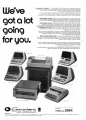
Advertisement


