Difference between revisions of "Beehive Alpha 101"
m (→Images) |
m (references) |
||
| (7 intermediate revisions by the same user not shown) | |||
| Line 7: | Line 7: | ||
| image = Beehive Alpha 101-8.jpg | | image = Beehive Alpha 101-8.jpg | ||
| display_size = 11-inch | | display_size = 11-inch | ||
| − | | interface = RS- | + | | interface = RS-232B |
| − | | baud_rates = 2400 | + | | interface2 = 20 mA current loop |
| + | | baud_rates = up to 2400 | ||
| char_resolution = 40x20 | | char_resolution = 40x20 | ||
| + | | char_matrix = 5x7 | ||
}} | }} | ||
| − | The {{PAGENAME}} terminal was introduced in January, 1970 at a price of $3,495.<ref>{{Citation | + | The {{PAGENAME}} was an early raster-scan CRT display terminal |
| + | manufactured by Beehive. The terminal was introduced in January, | ||
| + | 1970 at a price of $3,495.<ref name="datamation1970">{{Citation | ||
| journal = Datamation | | journal = Datamation | ||
| date = January 1970 | | date = January 1970 | ||
| Line 18: | Line 22: | ||
| page = 119 | | page = 119 | ||
| url = http://bitsavers.org/magazines/Datamation/197001.pdf | | url = http://bitsavers.org/magazines/Datamation/197001.pdf | ||
| + | }}</ref><ref name="ed1969">{{citation | ||
| + | | title=Economy CRT display shows 800 characters | ||
| + | | journal=Electronic Design | ||
| + | | volume=17 | ||
| + | | number=23 | ||
| + | | date=November 8, 1969 | ||
| + | | url=https://www.worldradiohistory.com/Archive-Electronic-Design/1969/Electronic-Design-V17-N23-1969-1108.pdf | ||
| + | | accessdate=March 6, 2026 | ||
| + | }}</ref><ref name="ca1969">{{citation | ||
| + | | title = TeleType compatible CRT computer display terminal | ||
| + | | journal = Computers and Automation | ||
| + | | volume = 18 | ||
| + | | number = 12 | ||
| + | | date = November, 1969 | ||
| + | | url = https://bitsavers.trailing-edge.com/magazines/Computers_And_Automation/196911.pdf | ||
| + | | accessdate = March 6, 2026 | ||
| + | }}</ref><ref name="mdMar1970">{{citation | ||
| + | | title = Alpha 101 CRT computer display terminal advertisement | ||
| + | | journal = Modern Data | ||
| + | | volume = 3 | ||
| + | | number = 3 | ||
| + | | date = March, 1970 | ||
| + | | url = http://bitsavers.org/magazines/Modern_Data/Modern_Data_1970_03.pdf | ||
| + | | accessdate = March 6, 2026 | ||
| + | }}</ref><ref name="mdJun1970">{{citation | ||
| + | | title = Interactive CRT Display Terminals, Part 2 - Alphanumeric CRT Terminals | ||
| + | | journal = Modern Data | ||
| + | | volume = 3 | ||
| + | | number = 6 | ||
| + | | date = June, 1970 | ||
| + | | url = http://bitsavers.org/magazines/Modern_Data/Modern_Data_1970_06.pdf | ||
| + | | accessdate = March 6, 2026 | ||
| + | }}</ref><ref name="hobbs1969">{{cite web | ||
| + | | title = Central Bibliographic System Terminal State of the Art Survey | ||
| + | | author = Hobbs Associates | ||
| + | | date = November, 1969 | ||
| + | | url = https://bitsavers.computerhistory.org/pdf/hobbsAssociates/LOC_Central_Bibliographic_System_Terminal_State_of_the_Art_Survey_Nov69.pdf | ||
| + | | accessdate = March 6, 2026 | ||
}}</ref> | }}</ref> | ||
| + | |||
| + | The Alpha 102 was an IBM compatible variant.<ref name="mdJun1970" /> | ||
| + | The Alpha 103 was a "TTY interchangeable" variant, implying it had a 20 mA current loop interface.<ref>{{citation | ||
| + | | title = Beehive Electrotech, Inc. advertisement | ||
| + | | journal = Modern Data | ||
| + | | volume = 3 | ||
| + | | number = 6 | ||
| + | | date = June, 1970 | ||
| + | | page= 16 | ||
| + | | url = http://bitsavers.org/magazines/Modern_Data/Modern_Data_1970_06.pdf | ||
| + | | accessdate = March 9, 2026 | ||
| + | }}</ref> | ||
| + | |||
| + | ==Description== | ||
| + | The Alpha 101 displayed text on an 11-inch cathode ray tube using a | ||
| + | raster-scan display system. The screen format consisted of 20 lines | ||
| + | of 40 characters, providing a total display capacity of 800 | ||
| + | characters.<ref name="ed1969" /> Characters were formed from a | ||
| + | 5 by 7 dot matrix stored in a character generator circuit.<ref | ||
| + | name="ed1969" /> | ||
| + | |||
| + | The terminal was designed as an electronic alternative to printing | ||
| + | teleprinter terminals, allowing users to view and edit text on a | ||
| + | video display instead of producing a printed record of each | ||
| + | interaction.<ref name="mdJun1970" /> | ||
| + | |||
| + | ==Operation== | ||
| + | Characters received from the host computer were stored in electronic | ||
| + | display memory and continuously refreshed on the CRT screen. The | ||
| + | terminal supported asynchronous serial communication through an | ||
| + | RS-232 interface at transmission speeds of up to 2400 | ||
| + | baud.<ref name="mdMar1970" /> | ||
| + | |||
| + | The keyboard included cursor movement and editing controls that | ||
| + | allowed the operator to move within the displayed text and modify | ||
| + | existing characters before transmitting them to the host | ||
| + | system.<ref name="mdJun1970" /> | ||
| + | |||
| + | ==Design== | ||
| + | The Alpha 101 employed semiconductor display memory together with a | ||
| + | MOS character generator to produce the video output.<ref | ||
| + | name="ed1969" /> The stored characters were translated into dot | ||
| + | patterns and written to the CRT during each raster scan refresh | ||
| + | cycle. | ||
| + | |||
| + | The physical terminal enclosure measured approximately 12 inches | ||
| + | wide, 14 inches high, and 20 inches deep and weighed about | ||
| + | 30 pounds.<ref name="ca1969" /> | ||
| + | |||
| + | ==Models== | ||
| + | The Alpha 101 was part of the Beehive Alpha series of CRT terminals. | ||
| + | Other members of the series included the Alpha 102, Alpha 103, and | ||
| + | Alpha 105.<ref name="mdJun1970" /> | ||
| + | |||
| + | These later models expanded the display capabilities of the series | ||
| + | while retaining a similar keyboard and display architecture.<ref | ||
| + | name="mdJun1970" /> | ||
| + | |||
| + | ==Historical context== | ||
| + | The Alpha 101 appeared during the early development of CRT display | ||
| + | terminals for interactive computing systems. During this period many | ||
| + | organizations were replacing printing teletypes with electronic | ||
| + | display terminals that allowed faster interaction with time-sharing | ||
| + | computers. | ||
| + | |||
| + | Contemporary surveys of terminal technology identified the Alpha | ||
| + | series as part of a growing class of CRT terminals using | ||
| + | semiconductor memory and character generators to display text on a | ||
| + | video screen.<ref name="hobbs1969" /> | ||
==Images== | ==Images== | ||
| Line 32: | Line 143: | ||
File:Beehive Alpha Jan1970.jpg|Advertisement | File:Beehive Alpha Jan1970.jpg|Advertisement | ||
File:Beehive Alpha 101 Modern Data 1970-03 advertisement.jpg|Modern Data advertisement | File:Beehive Alpha 101 Modern Data 1970-03 advertisement.jpg|Modern Data advertisement | ||
| + | File:Beehive Alpha 103, 105 Modern Data 1970-06 advertisement.jpg | ||
</gallery> | </gallery> | ||
Latest revision as of 21:40, 9 March 2026
| Beehive Alpha 101 | |
|---|---|
 | |
| Manufacturer | Beehive |
| Model | Alpha 101 |
| Lifetime | |
| Introduced | January, 1970 |
| Introductory Price | $3,495 |
| Communication | |
| Interfaces |
RS-232B, 20 mA current loop |
| Baud Rates | up to 2400 |
| Display | |
| Size | 11-inch |
| Character Modes | |
| Resolution | 40x20 |
| Matrix | 5x7 |
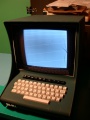
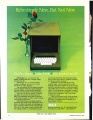
The Beehive Alpha 101 was an early raster-scan CRT display terminal manufactured by Beehive. The terminal was introduced in January, 1970 at a price of $3,495.[1][2][3][4][5][6]
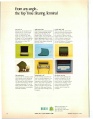
The Alpha 102 was an IBM compatible variant.[5] The Alpha 103 was a "TTY interchangeable" variant, implying it had a 20 mA current loop interface.[7]
Description
The Alpha 101 displayed text on an 11-inch cathode ray tube using a raster-scan display system. The screen format consisted of 20 lines of 40 characters, providing a total display capacity of 800 characters.[2] Characters were formed from a 5 by 7 dot matrix stored in a character generator circuit.[2]
The terminal was designed as an electronic alternative to printing teleprinter terminals, allowing users to view and edit text on a video display instead of producing a printed record of each interaction.[5]
Operation
Characters received from the host computer were stored in electronic display memory and continuously refreshed on the CRT screen. The terminal supported asynchronous serial communication through an RS-232 interface at transmission speeds of up to 2400 baud.[4]
The keyboard included cursor movement and editing controls that allowed the operator to move within the displayed text and modify existing characters before transmitting them to the host system.[5]
Design
The Alpha 101 employed semiconductor display memory together with a MOS character generator to produce the video output.[2] The stored characters were translated into dot patterns and written to the CRT during each raster scan refresh cycle.
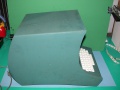
The physical terminal enclosure measured approximately 12 inches wide, 14 inches high, and 20 inches deep and weighed about 30 pounds.[3]
Models
The Alpha 101 was part of the Beehive Alpha series of CRT terminals. Other members of the series included the Alpha 102, Alpha 103, and Alpha 105.[5]
These later models expanded the display capabilities of the series while retaining a similar keyboard and display architecture.[5]
Historical context
The Alpha 101 appeared during the early development of CRT display terminals for interactive computing systems. During this period many organizations were replacing printing teletypes with electronic display terminals that allowed faster interaction with time-sharing computers.
Contemporary surveys of terminal technology identified the Alpha series as part of a growing class of CRT terminals using semiconductor memory and character generators to display text on a video screen.[6]
Images




Advertisement
Modern Data advertisement


References
- ↑ Datamation 16 (1): 119, January 1970, http://bitsavers.org/magazines/Datamation/197001.pdf
- ↑ 2.0 2.1 2.2 2.3 "Economy CRT display shows 800 characters", Electronic Design 17 (23), November 8, 1969, https://www.worldradiohistory.com/Archive-Electronic-Design/1969/Electronic-Design-V17-N23-1969-1108.pdf, retrieved March 6, 2026
- ↑ 3.0 3.1 "TeleType compatible CRT computer display terminal", Computers and Automation 18 (12), November, 1969, https://bitsavers.trailing-edge.com/magazines/Computers_And_Automation/196911.pdf, retrieved March 6, 2026
- ↑ 4.0 4.1 "Alpha 101 CRT computer display terminal advertisement", Modern Data 3 (3), March, 1970, http://bitsavers.org/magazines/Modern_Data/Modern_Data_1970_03.pdf, retrieved March 6, 2026
- ↑ 5.0 5.1 5.2 5.3 5.4 5.5 "Interactive CRT Display Terminals, Part 2 - Alphanumeric CRT Terminals", Modern Data 3 (6), June, 1970, http://bitsavers.org/magazines/Modern_Data/Modern_Data_1970_06.pdf, retrieved March 6, 2026
- ↑ 6.0 6.1 Hobbs Associates (November, 1969). "Central Bibliographic System Terminal State of the Art Survey". https://bitsavers.computerhistory.org/pdf/hobbsAssociates/LOC_Central_Bibliographic_System_Terminal_State_of_the_Art_Survey_Nov69.pdf. Retrieved March 6, 2026.
- ↑ "Beehive Electrotech, Inc. advertisement", Modern Data 3 (6): 16, June, 1970, http://bitsavers.org/magazines/Modern_Data/Modern_Data_1970_06.pdf, retrieved March 9, 2026
| This article is a stub. You can help the Terminals Wiki by expanding it. |

