Difference between revisions of "ADDS Viewpoint"
m (update from chatgpt) |
|||
| (14 intermediate revisions by the same user not shown) | |||
| Line 1: | Line 1: | ||
| − | + | {{Infobox terminal | |
| + | | manufacturer = ADDS | ||
| + | | model = Viewpoint | ||
| + | | image = ADDS Viewpoint 371058667762-1.jpg | ||
| + | | intro_month = June | ||
| + | | intro_year = 1981 | ||
| + | | intro_price = $650 | ||
| + | | phosphor = P4 white, P31 green | ||
| + | | display_size = 12-inch | ||
| + | | refresh_rate = 60 | ||
| + | | refresh_rate2 = 50 | ||
| + | | columns = 80 | ||
| + | | rows = 24 | ||
| + | | char_matrix = 7x8 | ||
| + | | char_cell = 8x10 | ||
| + | | status_line = Yes | ||
| + | | interface = RS-232C | ||
| + | | baud_rates = 110, 150, 300, 1200, 2400, 4800, 9600, 19200 | ||
| + | | attributes = normal reverse blink underline | ||
| + | }} | ||
| + | |||
| + | The '''{{PAGENAME}}''' was a low-cost asynchronous CRT display terminal | ||
| + | introduced in June 1981. The terminal was introduced at a list price of | ||
| + | $650 and was offered in two models, designated A and B. | ||
| + | {{InfoWorld | ||
| + | | name=infoworld_ncc | ||
| + | | id=yD0EAAAAMBAJ | ||
| + | | page_prefix=PT | ||
| + | | pg=40 | ||
| + | | title="NCC Mingles Micros, Minis and Mainframes" | ||
| + | | author=Thom Hogan | ||
| + | | date=June 22, 1981 | ||
| + | }} | ||
| + | {{Computerworld | ||
| + | | name=cw1981adds_viewpoint | ||
| + | | id=dPLZ7QidjbEC | ||
| + | | pg=73 | ||
| + | | title=ADDS advertisement | ||
| + | | date=June 15, 1981 | ||
| + | }}<ref>{{cite journal | ||
| + | | journal = Computer Decisions | ||
| + | | volume = 16 | ||
| + | | number = 9 | ||
| + | | date = July 1984 | ||
| + | | pages = 263ff | ||
| + | | title = 1984 VDT Comparison Guide | ||
| + | | url = https://bitsavers.org/magazines/Computer_Decisions/Computer_Decisions_V16_N07_198407.pdf | ||
| + | | accessdate = March 9, 2026 | ||
| + | }}</ref> | ||
| + | |||
| + | The Model B differed from the Model A primarily through the addition of | ||
| + | a glare filter intended to reduce reflections on the display screen in | ||
| + | brightly lit office environments.<ref name="cw1981adds_viewpoint"/> | ||
| + | |||
| + | The {{PAGENAME}} was marketed as an economical business terminal | ||
| + | suitable for data entry, interactive computing, and general-purpose | ||
| + | time-sharing applications. It was introduced during a period when | ||
| + | demand for inexpensive raster display terminals was increasing rapidly | ||
| + | due to the spread of minicomputers and multiuser microcomputer systems. | ||
| + | <ref name="infoworld_ncc"/> | ||
| + | |||
| + | ==Design and features== | ||
| + | |||
| + | The {{PAGENAME}} was a raster-scan CRT terminal with an integrated | ||
| + | keyboard and a self-contained desktop enclosure. Terminals of this | ||
| + | class typically combined the display electronics, power supply, and | ||
| + | monitor in a single unit intended for office use. | ||
| + | |||
| + | Asynchronous serial communication was standard for terminals of this | ||
| + | type, allowing connection to host computers through RS-232 or | ||
| + | 20 mA current loop interfaces. Such terminals were commonly used with | ||
| + | minicomputer systems and time-sharing services where a video display | ||
| + | terminal replaced earlier printing teletypes. | ||
| + | |||
| + | Advertising for the {{PAGENAME}} emphasized affordability and | ||
| + | compatibility with existing computer systems, positioning the terminal | ||
| + | as a practical replacement for earlier and more expensive display | ||
| + | terminals.<ref name="cw1981adds_viewpoint"/> | ||
| + | |||
| + | ==Market context== | ||
| + | |||
| + | During the early 1980s the market for video display terminals became | ||
| + | highly competitive as semiconductor integration reduced the cost of | ||
| + | display controllers and terminal logic. Manufacturers introduced | ||
| + | numerous low-cost models intended for office automation, data entry, | ||
| + | and distributed computing environments. | ||
| + | |||
| + | The relatively low introductory price of the {{PAGENAME}} reflected | ||
| + | this industry trend toward inexpensive desktop terminals. | ||
| + | Advertisements for the product continued to appear several years after | ||
| + | its introduction, indicating that the model remained available into | ||
| + | the mid-1980s. | ||
| + | {{Computerworld | ||
| + | | name=cw1984adds_viewpoint | ||
| + | | id=pwPLnCpM5wIC | ||
| + | | page_prefix=RA1-PA | ||
| + | | page=75 | ||
| + | | title=ADDS advertisement | ||
| + | | date=December 10, 1984 | ||
| + | }} | ||
| + | |||
| + | ==Images== | ||
| + | <gallery> | ||
| + | File:ADDS Viewpoint advertisement Computerworld 15Jun1981.jpg|Advertisement | ||
| + | File:ADDS Viewpoint 371058667762-1.jpg | ||
| + | File:ADDS Viewpoint 371058667762-2.jpg | ||
| + | File:ADDS Viewpoint 371058667762-3.jpg | ||
| + | File:ADDS Viewpoint 371058667762-4.jpg | ||
| + | File:ADDS Viewpoint 371058667762-5.jpg | ||
| + | File:ADDS Viewpoint 371058667762-6.jpg | ||
| + | File:ADDS Viewpoint 254215239203-1.jpg | ||
| + | File:ADDS Viewpoint 254215239203-2.jpg | ||
| + | File:ADDS Viewpoint 254215239203-3.jpg | ||
| + | File:ADDS Viewpoint 254215239203-4.jpg | ||
| + | File:ADDS Viewpoint 254215239203-5.jpg | ||
| + | File:ADDS Viewpoint 254215239203-6.jpg | ||
| + | File:ADDS Viewpoint 254215239203-7.jpg | ||
| + | File:ADDS Viewpoint 254215239203-8.jpg | ||
| + | File:ADDS Viewpoint 254215239203-9.jpg | ||
| + | File:ADDS Viewpoint 254215239203-10.jpg | ||
| + | File:ADDS Viewpoint 254215239203-11.jpg | ||
| + | File:ADDS Viewpoint 293103703422-1.jpg | ||
| + | File:ADDS Viewpoint 293103703422-2.jpg | ||
| + | File:ADDS Viewpoint 293103703422-3.jpg | ||
| + | </gallery> | ||
{{References}} | {{References}} | ||
| − | [[Category:ADDS|Viewpoint | + | [[Category:ADDS|Viewpoint]] |
| − | + | {{category raster}} | |
| − | |||
[[Category:1981]] | [[Category:1981]] | ||
| + | {{stub}} | ||
Latest revision as of 20:18, 9 March 2026
| ADDS Viewpoint | |
|---|---|
 | |
| Manufacturer | ADDS |
| Model | Viewpoint |
| Lifetime | |
| Introduced | June, 1981 |
| Introductory Price | $650 |
| Communication | |
| Interface | RS-232C |
| Baud Rates | 110, 150, 300, 1200, 2400, 4800, 9600, 19200 |
| Display | |
| Size | 12-inch |
| Phosphor | P4 white, P31 green |
| Refresh Rates | 60 Hz, 50 Hz |
| Character Modes | |
| Status Line | Yes |
| Attributes |
Normal, Blink, Reverse Video, Underline |
| Matrix | 7x8 |
| Cell | 8x10 |
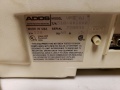
The ADDS Viewpoint was a low-cost asynchronous CRT display terminal introduced in June 1981. The terminal was introduced at a list price of $650 and was offered in two models, designated A and B. [1] [2][3]
The Model B differed from the Model A primarily through the addition of a glare filter intended to reduce reflections on the display screen in brightly lit office environments.[2]
The ADDS Viewpoint was marketed as an economical business terminal suitable for data entry, interactive computing, and general-purpose time-sharing applications. It was introduced during a period when demand for inexpensive raster display terminals was increasing rapidly due to the spread of minicomputers and multiuser microcomputer systems. [1]
Design and features
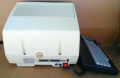
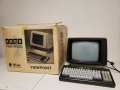
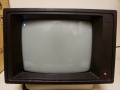
The ADDS Viewpoint was a raster-scan CRT terminal with an integrated keyboard and a self-contained desktop enclosure. Terminals of this class typically combined the display electronics, power supply, and monitor in a single unit intended for office use.
Asynchronous serial communication was standard for terminals of this type, allowing connection to host computers through RS-232 or 20 mA current loop interfaces. Such terminals were commonly used with minicomputer systems and time-sharing services where a video display terminal replaced earlier printing teletypes.
Advertising for the ADDS Viewpoint emphasized affordability and compatibility with existing computer systems, positioning the terminal as a practical replacement for earlier and more expensive display terminals.[2]
Market context
During the early 1980s the market for video display terminals became highly competitive as semiconductor integration reduced the cost of display controllers and terminal logic. Manufacturers introduced numerous low-cost models intended for office automation, data entry, and distributed computing environments.
The relatively low introductory price of the ADDS Viewpoint reflected this industry trend toward inexpensive desktop terminals. Advertisements for the product continued to appear several years after its introduction, indicating that the model remained available into the mid-1980s. [4]
Images

Advertisement










References
- ↑ 1.0 1.1 "NCC Mingles Micros, Minis and Mainframes", Thom Hogan, InfoWorld, June 22, 1981, pg. 40
- ↑ 2.0 2.1 2.2 ADDS advertisement, Computerworld, June 15, 1981, pg. 73
- ↑ "1984 VDT Comparison Guide". Computer Decisions 16 (9): 263ff. July 1984. https://bitsavers.org/magazines/Computer_Decisions/Computer_Decisions_V16_N07_198407.pdf. Retrieved March 9, 2026.
- ↑ ADDS advertisement, Computerworld, December 10, 1984, pg. 75
| This article is a stub. You can help the Terminals Wiki by expanding it. |

